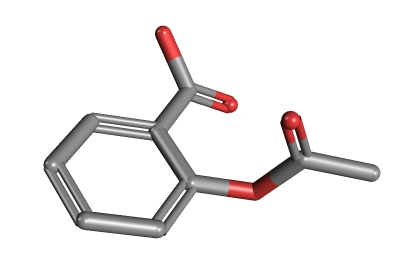
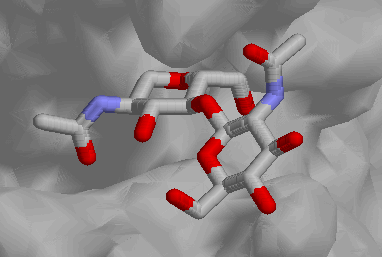
As the three-dimensional structures of an increasing number of small molecules and macromolecules became know, it became increasingly feasible to move from screening in vitro or in vivo to a least preliminary screening in silico to at least reject the least promising leads. The combination of highly automated laboratory techniques, large databases of annotated chemical and biological data, and computational chemistry has resulted in high throughput screening and a move from the ability to design drugs that may exist only as a computer model.
, as shown by pubchem.ncbi.nlm.nih.gov. This simple, but important, molecule
consists of 9 carbon atoms, 8 hydrogen atoms and 4 oxygen atoms, so we can describe it by chemical formula as
C9H8O4, but that tells us almost nothing about how where the various atoms are placed relative to one
another. Perhaps we should use a formula that puts related atoms near one another in the formula, as in this NIOSH formula for aspirin,
CH3COOC6H4COOH. That helps, put will a little more effort, we can use the SMILES representation,
CC(=O)OC1=CC=CC=C1C(=O)O, or the InChi representation, InChI=1S/C9H8O4/c1-6(10)13-8-5-3-2-4-7(8)9(11)12/h2-5H,1H3,(H,11,12), to give us enough
information for an accurate representation as a 2-dimensional chemical diagram. 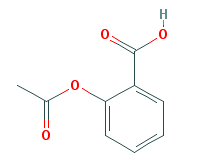 .
If we need more detail we can record the actual 3-dimensional coordinates to the atoms, using CIF,
as in COD entry 1515581, which is obtained from the Crystallographic Open Database
http://www.crystallography.net/cod/1515581.html.
There are many more representations of chemical information. A good starting point is to consider the Crystallographic
Information Framework (CIF), the Chemical Markup Language (CML), SMILES and InChi.
For CIF, look at the documentation and software at http://www.iucr.org/resources/cif/ and the original paper on CIF at http://scripts.iucr.org/cgi-bin/paper?es0164
For CML look at http://www.xml-cml.org/ and the paper at http://pubs.rsc.org/en/content/articlehtml/2001/nj/b008780g
For SMILES look at the wikipedia article at https://en.wikipedia.org/wiki/Simplified_molecular-input_line-entry_system and the paper at http://pubs.acs.org/doi/pdf/10.1021/ci00057a005. There is a good tutorial on the rules of smiles from http://www.daylight.com/dayhtml/doc/theory/theory.smiles.html
For InCHI see the wikipedia article at https://en.wikipedia.org/wiki/International_Chemical_Identifier and the paper at http://jcheminf.springeropen.com/articles/10.1186/s13321-015-0068-4 and the YouTube video at https://www.youtube.com/watch?v=rAnJ5toz26c
Much of rational drug design software is based on knowledge of three-dimensional atomic models of molecules. If you have accurate observations of element types and relative positions of atoms, you can make good estimates of bonding patterns and charges. With some techniques, you can even observe charge densities in addition to atomic positions. However, it become increasingly difficult to estimate the positions of individual atoms, the larger a molecule gets. Therefore you may not have accurate observations of individual atoms positions for the larger macromolecules. Instead what you are more likely to be able to observe are aggregations of atoms into groups or residues.
Therefore the primary representations of ligands are likely to be in terms of individual atoms (see the periodic table [Mendeleev, Dmitrii. "The relation between the properties and atomic weights of the elements" Journal of the Russian Chemical Society 1 (1869): 60-77] in https://en.wikipedia.org/wiki/Periodic_table), while the primary representations of macromolecules are likely to be in terms of sequences of residues, either amino acids (see https://en.wikipedia.org/wiki/Amino_acid) or nuclei acids (see https://en.wikipedia.org/wiki/Nucleic_acid). This difference makes the representation of ligands simpler than the representation of macromolecules.
The periodic table helps us to understand which elements are likely to bond to which other elements, forming compounds that will interact in predictable ways, an essential part of rational drug design.
This table of amino acids (from the RasMol Manual http://www.openrasmol.org/doc/ helps us to understand how the most commin residues in proteins will interact.
| Residues: | ala | arg | asn | asp | cys | glu | gln | gly | his | ile | leu | lys | met | phe | pro | ser | thr | trp | tyr | val |
|---|---|---|---|---|---|---|---|---|---|---|---|---|---|---|---|---|---|---|---|---|
| A | R | N | D | C | E | Q | G | H | I | L | K | M | F | P | S | T | W | Y | V | |
| Predefined Set | ||||||||||||||||||||
| A | R | N | D | C | E | Q | G | H | I | L | K | M | F | P | S | T | W | Y | V | |
| acidic | * | * | ||||||||||||||||||
| acyclic | * | * | * | * | * | * | * | * | * | * | * | * | * | * | * | |||||
| aliphatic | * | * | * | * | * | |||||||||||||||
| aromatic | * | * | * | * | ||||||||||||||||
| basic | * | * | * | |||||||||||||||||
| buried | * | * | * | * | * | * | * | * | ||||||||||||
| charged | * | * | * | * | * | |||||||||||||||
| cyclic | * | * | * | * | * | |||||||||||||||
| hydrophobic | * | * | * | * | * | * | * | * | * | * | ||||||||||
| large | * | * | * | * | * | * | * | * | * | * | * | |||||||||
| medium | * | * | * | * | * | * | ||||||||||||||
| negative | * | * | ||||||||||||||||||
| neutral | * | * | * | * | * | * | * | * | * | * | * | * | * | * | * | * | ||||
| polar | * | * | * | * | * | * | * | * | * | * | ||||||||||
| positive | * | * | * | |||||||||||||||||
| small | * | * | * | |||||||||||||||||
| surface | * | * | * | * | * | * | * | * | * | * | * | * |
For some desirable characteristics of a drug, see admet.html